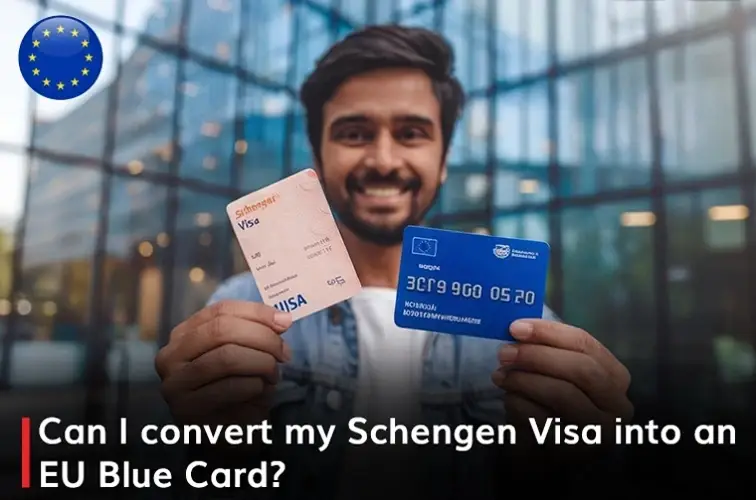
Learn about the requirements for obtaining the EU Blue Card especially for Germany job and residence opportunities for qualified professionals
The EU Blue Card is one of the most important residence and work permits issued by European Union countries especially Germany for highly skilled professionals and degree holders from non EU countries.
This card aims to attract qualified talent to strengthen the European economy and provides significant benefits, including long-term residence and easy family reunification.
What Is the EU Blue Card?
The EU Blue Card is a residence and work permit for non-EU citizens who hold a recognized university degree or equivalent professional qualification and have a valid job offer in an EU country.
In Germany, the Blue Card is granted to individuals who have a job offer with a contract of at least six months and an annual salary above a minimum threshold determined each year by the German government.

Eligibility Requirements for the Blue Card in Germany:
- Recognized University Degree or Equivalent Qualification
You must hold a degree recognized in Germany. You can verify this through the “Anabin” database or the Central Office for Foreign Education (ZAB). - Qualified Job Offer or Employment Contract
The offer must come from a German employer in a field that matches your academic or professional background. - Minimum Annual Salary (2025):
- €48,300 per year for general professions.
- €43,800 per year for shortage occupations (such as IT, medicine, and engineering).
- Valid Health Insurance in Germany
Health insurance is mandatory before and after entering Germany. - Clean Criminal Record and No Security Restrictions
Required Documents for the Blue Card Application
When applying, you must prepare a complete file containing the following:
| Document | Details |
|---|---|
| Valid passport | Must be valid for at least 12 months. |
| Employment contract or official job offer | Should include salary, workplace, and contract duration. |
| Curriculum Vitae (CV) | In German or English. |
| Original university degree with certified translation | With proof of recognition if required. |
| Proof of health insurance | From an approved German insurance provider. |
| Proof of residence or address in Germany (upon arrival). | |
| Recent passport-size photos | Meeting biometric standards. |
| Blue Card application form | Can be filled online or on paper. |
Steps to Apply for the German Blue Card
Step 1: Before Traveling to Germany
- Verify your degree recognition through Anabin or ZAB.
- Search for a job in your field through official German job portals:
- Obtain a formal job offer that meets the salary and qualification criteria.
- Apply for a national visa (Type D) at the German embassy in your country with all required documents.
Step 2: After Arriving in Germany
- Register your address at the local registration office (Bürgeramt).
- Submit your Blue Card application at the immigration office (Ausländerbehörde) in your city.
- Provide original documents and copies, and pay the application fee (usually €100–140).
- Wait for approval, which typically takes 6–12 weeks.
- Receive your German Blue Card, valid for four years or for the duration of your employment contract plus three months.
Benefits of the EU Blue Card
- Legal long-term residence and work in Germany.
- Easy family reunification without strict language requirements.
- Eligibility for permanent residence after 33 months (or 21 months if you reach German language level B1).
- Freedom to move to another EU country after 18 months of residence in Germany.
Official and Reliable
- Official German Government Immigration Portal:
- German Federal Foreign Office:
- Federal Office for Migration and Refugees (BAMF):
Conclusion
The EU Blue Card is a genuine opportunity for anyone seeking a secure and stable professional future in Europe, especially in Germany, which continues to welcome qualified professionals. With simplified procedures and lower income thresholds, the path to working and living in Europe has become easier than ever before.